



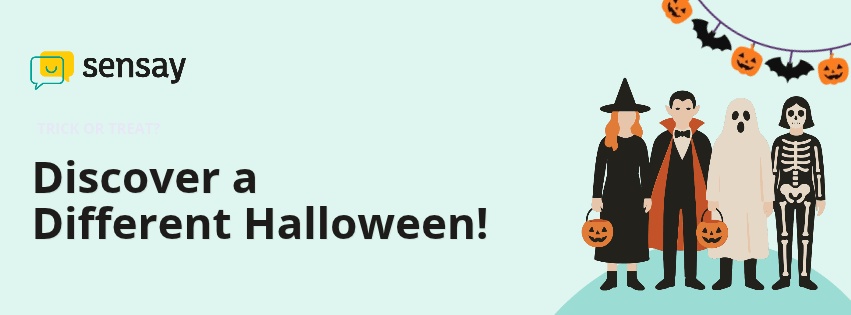
When you think of Halloween, what comes to mind first—jack-o’-lanterns, costume parties, or children excitedly calling out “Trick or treat!”?
Beyond candy and creative costumes, Halloween offers opportunities to explore different cultures and discover surprising seasonal traditions. Did you know that some people celebrate Halloween in the summer? And that Mexico’s Day of the Dead, often mentioned alongside Halloween, has its own distinct history and meaning?
Let’s explore these celebrations and discover how students’ curiosity can become an opportunity to speak English!
🌍 1. Halloween Around the World: Costumes, Creativity, and Culture
As Halloween has spread to different parts of the world, people have adapted it to their own interests and ways of celebrating.
The United States: Trick or Treat!
Children dress up, carry candy bags, and visit their neighbors while calling out “Trick or treat!” It’s one of the most familiar Halloween scenes. Jack-o’-lanterns, decorated yards, and costume parties help bring the festive atmosphere to entire neighborhoods.
Japan: Creativity Through Costumes
From classic monsters to anime characters, Halloween provides an opportunity to get creative with costumes. Makeup, accessories, and creative photos are all part of the fun.
Mexico: Discovering the Day of the Dead
When exploring celebrations around this time of year, Mexico’s Día de los Muertos, or Day of the Dead, is also worth learning about.
The Day of the Dead is not a Mexican version of Halloween. It is a separate tradition with its own history and meaning. Families honor loved ones who have passed away with flowers, food, and altars, keeping their memories and family connections alive.
Learning about these celebrations together helps students discover how different cultures express creativity, connect with others, and remember loved ones. In the English classroom, they also provide meaningful opportunities to observe, describe, and compare.
🎉 2. Halloween in the Summer? Meet Summerween
“Halloween in July” brings Halloween-themed activities into the summer vacation season. These celebrations are often called Summerween, a playful combination of summer and Halloween.
The name became widely known through a 2012 episode of Disney’s animated series Gravity Falls. In the story, the townspeople love Halloween so much that they celebrate it again in summer—even replacing pumpkin jack-o’-lanterns with carved watermelons!
Today, Summerween has made its way into real life through costume parties, campground trick-or-treating, and spooky decorations. It has no fixed date and isn’t limited to July.
🕯️ 3. Why Do We Love Halloween? Imagination, Costumes, and Shared Fun
Halloween’s appeal goes beyond candy and parties. It gives us a chance to step outside our everyday routines and try being someone different.
Children can become storybook wizards, brave heroes, or imaginary characters of their own creation. Adults can also enjoy getting creative with costumes, decorations, and games.
And Halloween doesn’t have to be scary. Cute pumpkins, silly monsters, and coordinated costumes with friends allow everyone to join in their own way.
Part of the excitement comes from preparing together: discussing costumes, making decorations, guessing each other’s characters, and taking photos of memorable moments. These shared activities create opportunities to connect and exchange ideas.
In the classroom, that same excitement can encourage students to speak English. When they have a character they want to introduce or a scene they want to describe, they have a meaningful reason to use the language.
💬 4. Turn Halloween Fun into Speaking Practice with Sensay
After exploring Halloween’s culture and creativity, it’s time for students to share their own observations and ideas in English!
The Sensay Halloween Practice Pack combines seasonal themes with speaking activities for different proficiency levels, helping teachers choose exercises that suit their students’ abilities and learning goals.
A1–A2 | Start with Pictures and Simple Questions
Reading activities with images and video-based questions help beginners understand prompts, build theme-related vocabulary, and respond in simple sentences while gaining confidence in speaking.
B1–B2 | Develop More Detailed Responses
Halloween stories, scene descriptions, and role-playing activities encourage students to add details and express their ideas more clearly and fully.
C1–C2 | Explore Ideas and Express Opinions
In-depth reading and critical-thinking questions guide advanced learners to analyze content, support their opinions with reasons, and organize their responses.
From “Trick or Treat” to “The Spirit of Halloween,” these activities take students beyond learning vocabulary and give them opportunities to describe, tell stories, and share opinions.
🎃 5. Turn Halloween Imagination into English Expression
From celebrations around the world to Halloween in summer, seasonal traditions offer plenty of stories to explore and topics to discuss in English.
A Halloween English lesson can begin with something simple: introducing a favorite costume, describing an interesting picture, or explaining which activity sounds the most fun. Start with something students want to share, then help them express it in English, one step at a time.
This Halloween, choose an activity from the Sensay Halloween Practice Pack and let your students bring their curiosity, imagination, and Halloween stories to life in English!