



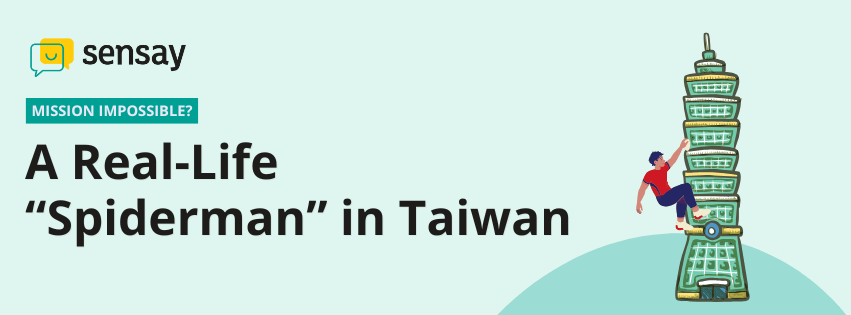
Recently, a dramatic scene from Taiwan caught global attention. A professional climber known as a “real-life Spiderman,” Alex Honnold, climbed Taipei 101 without using safety gear. The entire climb was covered by English-language media, allowing audiences around the world to witness this extreme challenge in real time.
The height of the building and the intensity of the climb kept viewers holding their breath.
These striking images were not only shocking,but quickly became a major topic of public discussion.
What Exactly Happened?
Alex did not attempt this climb on impulse.
He is a professionally trained climber with years of experience and physical preparation. For him, climbing Taipei 101 was a carefully planned and evaluated personal challenge, not something that untrained individuals should try or imitate.
In the broadcast footage, viewers can see how cautiously Alex climbs upward, with each movement controlled and deliberate. While the scenes may look like something from a movie, they are built on years of training, repeated practice, and a clear understanding of risk.
This is why the event deserves to be clearly explained rather than simply admired.
Three Important Lessons Students Can Learn
1️⃣ Behind every challenge is long-term preparation
Children are often drawn to impressive results but may overlook the process behind them.
This story helps students understand that truly difficult achievements usually come from long-term effort and continuous practice—not from sudden or reckless decisions.
2️⃣ Chasing dreams does not mean copying every action
Alex’s climb is admirable, but it must be clearly stated that this was a highly professional and extremely dangerous activity. It is not suitable for people without proper training.
Admiring someone’s courage does not mean copying their behavior.
3️⃣ Courage also requires risk awareness
This event offers a valuable opportunity for students to learn how to distinguish between attitudes worth learning from and actions that should be avoided.
Developing this kind of judgment is an important part of building critical thinking skills.
Sensay Classroom Practice Pack | For Grades 3–6
To help bring this real-life event into the classroom in a safe, clear, and age-appropriate way, Sensay has introduced a classroom practice pack designed for Grades 3–6.
The practice pack is centered on reading aloud, guiding students through the story sentence by sentence. Students learn about the background, process, and outcome of the event while naturally encountering ideas such as training, challenge, and safety.
It also includes an open-ended question unit (Think & Reflect), encouraging students to connect the story to their own experiences. Students are guided to think about challenges, effort, and safety, and to express their ideas in simple English.
Teachers can flexibly use this pack for reading, speaking, or class discussion, depending on their students’ levels.
Extension Listening Practice for Higher-Level Students
For students with higher English proficiency, teachers can also incorporate authentic English video materials for listening practice:
🎥 English media coverage of the climb
https://www.youtube.com/watch?v=ZXiEp_GGSpg
🎤 Alex’s interview on Jimmy Kimmel Live (a talk show)
https://www.youtube.com/watch?v=1vle6fLJ91g
Teachers may guide students to:
- predict the topic before watching
- listen for key information
- summarize what they hear in simple English
- share their thoughts and feelings
This helps connect language learning with real-world content.
The Message About Chasing Dreams
Alex Honnold’s climb of Taipei 101 is impressive and shows great courage and determination.
More importantly, it reminds us that every remarkable achievement is supported by long-term preparation, training, and careful risk evaluation.
Chasing dreams is something positive and meaningful. It represents the willingness to try, to work hard, and to take action toward a goal. However, a mature attitude toward dreams is not simply “doing whatever we want.” It means moving forward within our abilities and always putting safety first.
When children learn to see dreams this way, what they gain is more than inspiration. They learn how to move forward step by step, toward growth that is safer, more thoughtful, and more sustainable.